
Overview
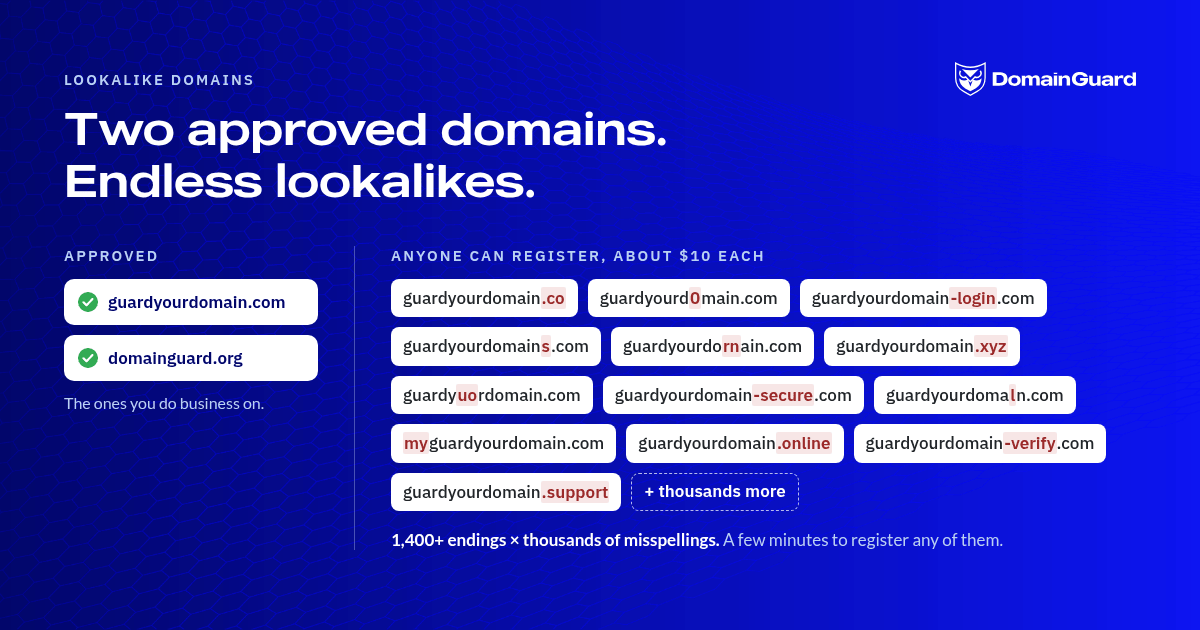
Every organization has a short list of approved domains: the ones it actually does business on. For us, those are guardyourdomain.com and domainguard.org. Approved domains are the addresses your customers, partners, and employees are supposed to trust, on your website, in your email, and on your login pages.
An impersonation domain, also called a lookalike domain, is any other domain that could pass for one of them. Some keep the name and change the ending, such as guardyourdomain.co. Others change the name itself, with a swapped character in guardyourd0main.com or an added word in guardyourdomain-login.com. Read quickly, on a phone or inside a link, any of them can pass for the real thing.
The problem is scale. There are more than 1,400 domain endings, from .com to .co to .online. A single name can be misspelled, rearranged, or extended thousands of ways, and each version can be registered on hundreds of those endings. Anyone can register one in a few minutes for as cheap as $2 to $12, and registering one is not a crime, although registering one in bad faith to profit from your trademark can still get someone sued. Until the domain is used to deceive someone, it usually breaks no rule that the companies selling and hosting domains are obliged to enforce.
So when should you pursue a takedown? It depends on what the domain is doing.
- If it is doing harm, act right away. An impersonation domain hosting a phishing page, a fake login, or a scam breaks the terms registrars and hosting providers operate under. A documented abuse report, sent to the right registrar and host, has no filing fee and often gets the domain suspended within hours.
- If it is only registered, watch it. Registrars act on abuse, not on resemblance. A lookalike that is parked, empty, or listed for sale can only be removed through a formal trademark dispute such as the UDRP, which starts at $1,500 in filing fees and takes about two months, for a domain that cost its owner around $10. That is worth it for a few high-value names, not for every lookalike.
- What works: watch every lookalike, act the moment one turns malicious, block what you cannot remove, and keep the evidence on file in case a legal route ever makes sense.
Types of Takedowns, and the One DomainGuard Conducts
“Takedown” covers a few different processes, and only one of them is fast and free to file. Every takedown needs three things to line up: someone with the authority to remove the domain, a rule the domain is breaking, and evidence that it is breaking it.
The authority sits with a few companies, none of which work for you. The registrar sold the domain (GoDaddy, Namecheap, and hundreds of others). The registry runs the ending, such as Verisign for .com. The hosting provider runs the server where any website lives. Each will act when one of its rules is broken. None of them owes you a takedown because a name resembles yours.
The rule being broken decides the type of takedown:
- DNS abuse takedown. Under their contracts with ICANN, the organization that coordinates the domain name system, registrars and registries must act on DNS abuse: malware, botnets, phishing, pharming, and spam used to deliver any of those. Since April 2024, those contracts require them to act promptly once they have actionable evidence of it. (ICANN) Hosting providers ban the same activity in their terms of service. Filing a documented report has no fee, and it often gets results within hours.
- Trademark dispute. A domain that infringes your trademark can be transferred to you or cancelled through a proceeding under the Uniform Domain-Name Dispute-Resolution Policy (UDRP) or a country’s own policy for endings such as
.uk, or suspended through a faster process for clear-cut cases (the URS). These work on parked domains too, but they cost money, take weeks to months, and you have to show the registrant acted in bad faith. - Legal action. A cease-and-desist letter or a lawsuit. Both usually need someone to send them to, which means identifying who is behind the domain. A US lawsuit against the domain itself is the exception, but it can only win the domain, not damages.
Resemblance alone does not qualify for the first type. A domain that looks like your brand but hosts nothing, a parking page full of ads, or a “this domain is for sale” banner is not DNS abuse, and registrars do not decide trademark disputes. So an abuse report about a parked lookalike usually comes back “no abuse found,” or does not come back at all.
DomainGuard conducts DNS abuse takedowns. We file them once malicious intent is documented: a phishing page, a fake login, or a domain sending phishing email, captured in evidence an abuse desk can act on. The day a parked lookalike stands up a fake login page, it crosses that line. Now there is a rule being broken, evidence to show, and a registrar with a contractual duty to act. That is why, in this work, timing matters more than anything else.
For trademark disputes and legal action, we supply the evidence and work with your legal team. Our system gathers evidence on every lookalike from the day we first see it, whether or not it ever does anything: screenshots, DNS and mail records, registration details, and timestamps. If you decide a domain is worth a UDRP complaint or a cease-and-desist letter, that record is ready.
That is the value of continuous monitoring, even for domains nobody can take down yet. A lookalike that is parked today can turn malicious tomorrow. The record built while it sat quiet is what lets us move the moment it turns, and what gives your attorneys a case if it never does.
The Economics: $10 to Register, Thousands to Remove
Here is what each side pays.
| Action | Who pays | Typical cost | Typical time |
|---|---|---|---|
Register a lookalike .com | The attacker | About $11 to $23 a year | Minutes |
| Register a lookalike on a cheap ending | The attacker | About $2 for the first year | Minutes |
| Abuse report for active phishing | You | No filing fee | Hours to days |
URS complaint (not .com or .net) | You | A few hundred dollars | About three weeks |
| UDRP complaint at WIPO, one to five domains | You | $1,500 filing fee plus attorney fees | About two months |
| Expedited UDRP complaint at WIPO | You | $4,000 filing fee plus attorney fees | About one month |
| Federal lawsuit under the ACPA | You | Often six figures if contested | Months to years |
Three things make that table worse than it looks.
The attacker can replace a domain faster than you can dispute it. A UDRP decision covers only the domains named in the complaint. If you spend two months and several thousand dollars recovering guardyourdomain-login.com, the person behind it can register guardyourdomain-secure.com the same afternoon for $11.
Your exact name can be registered more than a thousand times over. Before anyone misspells anything, there is the ending. IANA, which keeps the internet’s master list, currently counts 1,437 top-level domains: about a thousand generic endings from .com to .support, .online, and .xyz, 248 two-letter country codes such as .uk, .ca, and .co, and about 150 more in non-Latin scripts. Some are reserved for a single company or limited to local residents, but hundreds will sell guardyourdomain to anyone with a credit card, no typo required. Some endings are traps on their own: guardyourdomain.co is the exact name, one dropped keystroke away from .com. Registering your exact name under every open ending would cost thousands of dollars a year, renewing forever, before a single typo is covered.
Then come the variations. One brand name produces thousands of plausible typos, swapped characters, and brand-plus-word combinations, and each one multiplies across those same endings. You cannot litigate your way through that list, and you cannot register all of it defensively either.
Who Is Behind It? Usually, Nobody You Can Name
A letter or a lawsuit needs someone to send it to, and identifying the person behind a lookalike is rarely possible.
- Registration details are hidden. Since GDPR took effect in 2018, most public domain records hide the owner, either redacted by the registrar or, more often, replaced with a privacy service’s details. One study of 2024 registration data found only about one in ten generic domains showing contact details for the actual owner. (Interisle) ICANN’s Registration Data Request Service lets you ask a registrar to disclose them, but registrar participation is voluntary, and in the service’s two-year pilot only about a quarter of requests were approved. (ICANN)
- The money leads nowhere. Domains and hosting are paid for with cryptocurrency, prepaid cards, or stolen credit cards.
- The infrastructure may belong to someone else. The best case for an attacker is a hijacked website or a compromised hosting account. They pay nothing, and the trail leads back to an innocent victim.
- Privacy is a feature, even for bad actors. Services such as Cloudflare sit in front of many phishing sites. Cloudflare does act on phishing reports, forwarding them to the site’s operator and real host and showing visitors a warning page, but the public cannot see where a site behind it is really hosted.
- Attackers are global. The operator, the registrar, the hosting provider, and the victim can be in four different countries, each with its own laws and its own clock.
The internet’s distributed design is a double-edged sword. It lets anyone reach anyone, anywhere, and it lets anyone impersonate anyone, anywhere.
Who Registers Lookalike Domains
Not every lookalike is the same problem, and the right response depends on who is on the other side.
Phishing and fraud crews. They register disposable domains, often on endings that cost about $2 for the first year, and use them for hours or days. Interisle’s 2025 phishing study found that newer generic endings make up 11% of the domain market but 51% of phishing domains. A study run with PayPal and Google found the average phishing attack lasts about 21 hours from first victim to last. A takedown that starts when a customer calls to report a fake login has already missed most of that window, which is why detection has to run around the clock. Once a documented report reaches the registrar and host, the domain usually comes down fast, and the crew expects that. Legal action is pointless here: by the time a complaint is drafted, the domain is dead and the operation has moved to the next one.
Professional domain squatters. Some registrants, often called domainers, hold portfolios of thousands of typo and brand-adjacent domains. A 2010 study by researchers Tyler Moore and Benjamin Edelman estimated at least 938,000 typo domains aimed at 3,264 popular .com sites; of those it could classify, about 80% earned money from pay-per-click ads. Others sell the domains, sometimes to the brand itself. They rarely host phishing, so abuse desks have nothing to act on, and losing a UDRP case costs them only the domain in question, because panels cannot award damages. Paying their asking price tells them your brand is worth squatting on. A lookalike with mail records set up can also quietly collect misaddressed email: in 2011, researchers at the Godai Group who registered lookalikes of Fortune 500 email domains collected more than 120,000 misdirected emails in six months. That is a good reason to watch them even when they look harmless.
Competitors and opportunists. Sometimes the person behind a lookalike is a business you can name, and that changes everything. Imagine a credit union with a name close to yours that registers lookalikes of your domain and points them at its own website. That is deliberate, and it supports a claim of trademark infringement or unfair competition. One of our customers faced exactly this. Its attorneys resolved it with a cease-and-desist letter built on our timestamped record of each domain.
Legitimate coincidences. Plenty of names are shared in good faith. We hold a US trademark on the DomainGuard name, and a trademark helps, but it is rarely black and white. Nissan Motor learned this over nissan.com. Uzi Nissan had used his surname in business since 1980 and registered the domain in 1994 for his computer company. Nissan Motor sued in 1999 to take it. Nearly five years later, an appeals court gave the automaker only part of what it wanted. Uzi Nissan had to stop running car ads on the site, because those traded on Nissan Motor’s trademark, but he kept the domain, because he had registered it in good faith for his own business under his own name. The trademark stopped one way of using the name. It did not make the name Nissan Motor’s. Trademarks are granted by country or region and for particular goods and services, and a common word or a surname can be someone’s legitimate business name. A UDRP complaint against someone with a genuine interest in a name will fail, and one filed in bad faith can earn the complainant a finding of reverse domain name hijacking.
Telling these apart takes two kinds of judgment. An analyst confirms intent before anything is filed, and your feedback covers what only you know. When you confirm a flagged domain is legitimate, whether it belongs to a partner, a franchisee, or an unrelated business with its own claim to the name, we mark it that way, so no one spends money chasing it.
Every Avenue, Compared
| Avenue | Works when | What it can do | Cost and time |
|---|---|---|---|
| Abuse report to registrar and host | The domain is phishing, spreading malware, or defrauding people | Suspend the domain or remove the content | No filing fee; hours to days |
| Browser and email blocklists | Active phishing or malware | Warn and block visitors while the takedown is pending | No fee; often within hours |
| URS | A clear-cut case, a registered trademark, and an ending that uses the URS (not .com or .net) | Suspend the domain until its registration expires | A few hundred dollars; about three weeks |
| UDRP | The domain infringes your trademark and was registered and used in bad faith | Transfer the domain to you, or cancel it | $1,500 filing fee plus attorney fees; about two months, or one month on the $4,000 expedited track |
| Country-code dispute policy | A lookalike on an ending such as .uk or .ca | Varies by country; often transfer | Varies; £750 for a full .uk decision, about CAD 3,350 for .ca |
| Cease-and-desist letter | You can identify the registrant | Persuade them to stop and hand over the domain | Attorney time |
| Lawsuit (ACPA in the US) | An identifiable registrant acting in bad faith, or the domain itself when the owner cannot be found | Damages, transfer, or forfeiture | Often six figures if contested; months to years |
| Buying the domain | A single high-value name at a fair price | You own it | The asking price; days |
| Defensive registration | The most obvious variants, before anyone else gets them | You own them | Annual renewals for every name |
| Registry blocking service | Your trademarked name on participating endings, before anyone registers it | Prevent new registrations of the blocked names | A few thousand dollars a year per trademark |
Abuse Reports and Blocklists
This is the workhorse. When a lookalike hosts phishing or fraud, a well-documented report to the registrar and the hosting provider, filed in parallel, gets most domains suspended within hours to a couple of days. Our phishing site takedown guide shows how to file a single report yourself.
One report is manageable. The hard part is everything around it, repeated for every lookalike that turns malicious:
- Hundreds of registrars, thousands of hosting providers. Each runs its own abuse desk. Some take reports by email, others only through a web form, sometimes behind a login, and each wants evidence in its own format. A report in the wrong format can be rejected without anyone telling you.
- The listed contact is often the wrong one. The brand on a registration is often a reseller’s rather than the registrar accountable for the domain, and a website’s address often leads to a service such as Cloudflare rather than the actual host. A report filed with the wrong party goes nowhere. Contacts also move when providers merge or rebuild their abuse portals.
- Country-code endings play by their own rules. ICANN’s abuse obligations cover generic endings such as
.comand.shop. The 248 two-letter country-code endings, from.ukto.mx, and their non-Latin counterparts run under their own policies instead. Some publish little registration data, some expect reports in their own language, and some cases go through national authorities rather than an abuse desk. One of ours ran through Mexico’s National Guard. - Relationships speed things up. Abuse desks are flooded with vague or mistaken reports. A sender they know, with a record of accurate evidence, gets read sooner, and at a registrar where we have a direct point of contact, a confirmed phishing domain can be suspended within hours. That trust is built one correct report at a time.
That is the practical case for managed monitoring and takedowns. We catch the lookalike the moment it turns, file with the right registrar and host in the format each desk accepts, follow up until the domain is down, and keep the full case history. Your team gets the outcome and the record without learning a single abuse desk or chasing a ticket.
Blocklists protect people while you wait. Google Safe Browsing, which protects Chrome, Firefox, and Safari users, and Microsoft’s SmartScreen show visitors a red warning page once a URL is confirmed as phishing. Feeding lookalikes into your email gateway and web filter means lures dead-end at your users even before a takedown lands, and even for domains no one will ever take down.
UDRP and URS
To win a UDRP case, you have to show three things: the domain is identical or confusingly similar to a trademark you have rights in, the registrant has no rights or legitimate interests in it, and it was registered and is being used in bad faith. Complainants who see a case through usually win: WIPO handled a record 6,282 cases in 2025, and about 92% of the decided ones ended in a transfer. (WIPO caseload, outcomes) But a win is narrow. The panel can transfer the named domains to you or cancel them, and that is all: no damages, no recovered legal fees, and nothing that stops the next registration. A standard case takes about two months. WIPO’s expedited track, added in 2026, aims for one month and costs $4,000 to file.
It is the right tool for a specific job: a high-value name you want to own outright, such as your exact brand on .com or a typo that is collecting your customers’ email, held by a squatter who will not let it go. It is the wrong tool for disposable phishing domains, which are usually suspended through the abuse process long before a panel would rule.
The Uniform Rapid Suspension System (URS) is a cheaper, quicker cousin for clear-cut cases. It applies to the newer generic endings and a few legacy ones such as .org, but not .com or .net. It requires a registered trademark and clear and convincing evidence, and its only remedy is suspension until the registration runs out. After that, anyone can register the domain again.
Endings tied to a country, such as .uk, .ca, or .us, follow their own dispute policies. Many resemble the UDRP, but the details differ: a full expert decision in a .uk dispute costs £750, a .ca case runs about CAD 3,350, and the .us policy requires bad faith in registration or use rather than both.
Letters and Lawsuits
A letter from your attorney is often the most effective legal step there is, but only when you know who to send it to. In practice that means competitors, resellers, and other registrants with a reputation or a business to protect.
In the United States, the Anticybersquatting Consumer Protection Act (ACPA) allows statutory damages of $1,000 to $100,000 per domain, and an action against the domain itself when the owner cannot be found. It is a federal lawsuit with federal-lawsuit costs: for a trademark infringement suit with less than $1 million at stake, the median cost through trial is about $250,000, according to the AIPLA’s 2023 economic survey, and costs rise with the stakes. It makes sense against a well-funded, identifiable party, and almost never against an anonymous phishing crew.
Buying and Defensive Registration
Sometimes the cheapest option is to pay the asking price. For a single valuable name at a reasonable price, that can beat a UDRP complaint on both cost and speed. As a policy it backfires, because it funds the squatter’s next registration and marks your brand as one that pays. Keep any offer to sell, too: an unsolicited offer to sell you the domain for more than it cost to register can support a finding of bad faith in a UDRP case.
Defensive registration has the same limit. Register a short list yourself: your exact name on the major endings, the most obvious typos, and the hyphenated form. Registry blocking services such as GlobalBlock and Identity Digital’s DPML can block a trademarked name, and some variants, across hundreds of endings for a few thousand dollars a year per mark, but they only block names nobody has registered yet, and they do not cover .com. Beyond that, the math stops working, which is where monitoring takes over.
How We Handle It, and What We Recommend
Our approach comes down to this: watch everything, move the moment there is abuse, and save legal action for the cases where it pays off.
- Monitor every lookalike, not only the active ones. A new registration is a signal. Mail records, a TLS certificate, or a login form appearing on it is a countdown.
- Act the moment there is abuse. When a lookalike turns malicious, the registrar’s contractual duty kicks in. We file with the registrar and the host in parallel, notify browser blocklists, and follow up until removal is confirmed. Our fastest takedowns go from detection to a submitted report in under 120 seconds.
- Block what you cannot remove. We supply the lookalike and threat domains we track as a feed your email gateway, DNS filter, and web proxy can block today, whether or not anyone ever takes them down.
- Document every case. Each takedown’s full history, from detection and evidence through every submission, response, and confirmed removal, stays in the platform for your security, audit, and legal teams.
- Escalate until it comes down. If a registrar or host stalls on documented abuse, we re-submit, try alternate contacts, go to the hosting provider, and escalate to ICANN compliance where warranted. When a lookalike traces back to someone your attorneys can pursue, such as a competitor, your legal team gets our full record to build a cease-and-desist letter or a UDRP complaint.
- Register a short list defensively. Own your exact name on the major endings and the obvious typos. Let monitoring cover the rest.
You do not need to win a legal fight over every $10 domain. You need someone watching each one, ready to move the moment it turns, and a record your attorneys can use if one is ever worth the fight.
Frequently Asked Questions
How much does it cost to take down a lookalike domain?
If the domain is hosting phishing, malware, or fraud, there is no filing fee: abuse reports to the registrar, the hosting provider, and browser blocklists are free to submit. The work is in finding the right desk, building evidence it will accept, and following up until the domain is down. If it is only registered, the main route is a UDRP complaint. WIPO's filing fee is $1,500 for one to five domains decided by a single panelist, or $4,000 with a three-member panel or on WIPO's expedited track, plus attorney fees if you use one. A lawsuit costs far more again: for a trademark infringement suit with less than $1 million at stake, the median cost through trial is about $250,000, according to the AIPLA's 2023 economic survey, and it rises with the stakes. The domain itself cost its owner about $10.
Why won't the registrar remove a domain that copies our name?
Registrars are obligated to act on DNS abuse, which ICANN defines as malware, botnets, phishing, pharming, and spam used to deliver those. A domain that only resembles your brand is not abuse under that definition. It may infringe your trademark, but registrars do not decide trademark disputes; ICANN routes those to UDRP proceedings or the courts. Once the domain starts phishing or impersonating you to defraud people, the registrar has grounds to act.
How long does a UDRP complaint take?
WIPO cases typically run about two months from filing to decision. Since March 2026, WIPO also offers an expedited track that aims for a decision in about a month, for a $4,000 filing fee. If the panel orders a transfer, the registrar waits ten business days before implementing it, in case the registrant files a lawsuit. The decision only covers the domains named in the complaint, so a new variant registered the next day needs a new complaint.
Can we find out who registered a lookalike domain?
Rarely. Since GDPR took effect in 2018, most public domain records hide the owner, either redacted by the registrar or, more often, replaced with a privacy service's details. One study of 2024 registration data found only about one in ten generic domains showing contact details for the actual owner. You can request disclosure from the registrar, including through ICANN's Registration Data Request Service, but registrar participation is voluntary, and in the service's two-year pilot only about a quarter of requests were approved. Payments in cryptocurrency or with stolen cards, and attacks run from hijacked infrastructure, usually end the trail.
Should we buy a lookalike domain from the person selling it?
Occasionally, for one high-value name at a low price, buying is cheaper and faster than a UDRP complaint. As a habit it backfires: paying a squatter tells them your brand is worth squatting on, and every purchase funds the next registration. For most parked lookalikes, monitoring costs less than either buying or disputing them.
What is the difference between UDRP and URS?
Both are trademark procedures, not abuse reports. The UDRP applies to every generic top-level domain including .com, takes about two months, and can transfer the domain to you or cancel it. The Uniform Rapid Suspension System is cheaper and faster but applies only to newer generic endings and a few legacy ones such as .org, not .com or .net. It requires a registered trademark and clear and convincing evidence, and can only suspend the domain until its registration expires, after which anyone can register it again.
Can we sue someone for registering a lookalike domain?
In the United States, the Anticybersquatting Consumer Protection Act allows statutory damages of $1,000 to $100,000 per domain against a registrant who registered it with a bad-faith intent to profit from your mark, and an in rem action against the domain itself when the owner cannot be found. It is a federal lawsuit, and costs scale accordingly: for a trademark infringement suit with less than $1 million at stake, the median cost through trial is about $250,000, according to the AIPLA's 2023 economic survey. It makes sense against an identifiable party with assets, such as a competitor, and almost never against an anonymous phishing operation.