
DomainGuard threat intel, published for defense. Security teams can use it to detect and block this technique; anyone who runs into it can use it to recognize the lure and stay safe. Indicators of compromise are defanged.
What it is
FedEx voicemail phishing is a voice phishing, or vishing, campaign that impersonates the parcel carrier to steal payment card data. An automated voicemail claims there is a problem with a package’s delivery address and names a website to visit before a deadline. The site is a cloned FedEx tracking page that asks for a small redelivery fee.
Fake delivery-fee lures have run by text and email for years. Delivering one by voicemail sidesteps the filters built for those channels. The recording never names FedEx; the brand appears only in the domain, a brand-plus-suffix lookalike domain such as fedexwm[.]com or fedexyd[.]com. The operator rotates through them, registering new ones almost daily as registrars suspend the old.
If you already entered your card
The payment page collects everything needed to use a card online. An error after you submit it, such as a request for a different card, does not mean the details were not captured.
- Call your card issuer now. Use the number on the back of the card, report the fraud, and ask for a replacement card rather than monitoring the old one. If you entered a second card after the error, replace that one too.
- Expect follow-up scams. The kit also collects your name, address, email, and phone number. Treat unexpected calls, texts, or emails that cite them as suspect, including ones that claim to be from your bank or FedEx.
- Report it. Send the details to FedEx at
[email protected], the address it gives for suspicious messages, and in the US file a report at reportfraud.ftc.gov.
Is the website in my voicemail part of this scam?
If the voicemail named a website made of “fedex” plus one to three letters and .com, treat it as this scam. FedEx tracking lives only on fedex.com.
The ones people have searched for or reported include fedexwm, fedexyd, fedexvy, fedexvw, fedexfd, fedexvr, fedexpw, fedexkwp, fedexgw, and fedexfw, all .com. As of October 7, 2026, we have tied 129 domains in this pattern to the campaign, the earliest registered on September 3, and about 280 have been registered in it, often several in the same minute. New ones appear almost daily, so a name not listed here is not a sign that it is safe.
On a computer, the website opens apple.com. The site checks what kind of device is visiting. Phones get the fake verification page; computers are redirected to Apple’s homepage, so checking the link from a laptop shows nothing wrong. The redirect does not make the site safe, and Apple has nothing to do with it.
How it works
Voicemail Lure. An automated delivery notice warns of a problem with the package’s delivery address, names a website to visit by a deadline one day out, and says the package will otherwise go back to the sender. Caller numbers rotate; the reported ones share the 986 area code. On iPhone, the voicemail transcript renders the spoken domain as a tappable link.
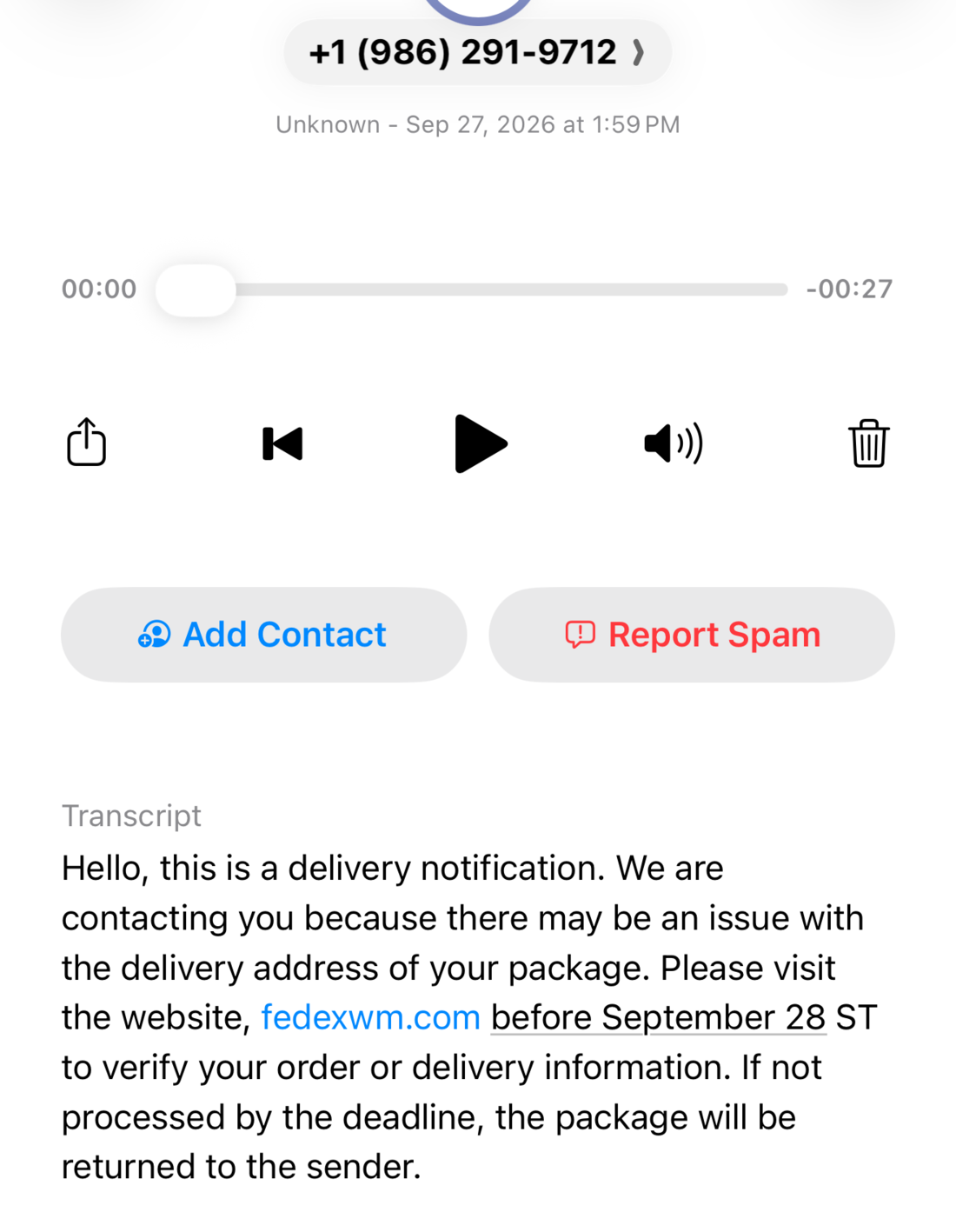
Voicemail from the campaign, with the lookalike domain rendered as a tappable link in the transcript. Fake Cloudflare Gate. The lookalike domain first checks the visitor’s browser. Computers are redirected to apple.com; phones get a Cloudflare-style checkbox asking the visitor to prove they are human. It is not Cloudflare: the page comes from a Python (Uvicorn) app behind a Caddy proxy, and the Ray ID is a random value generated in the browser. Unlike the ClickFix version of this lure, it asks only for a click, which is logged to
/api/click_reportbefore the victim is forwarded to a second domain.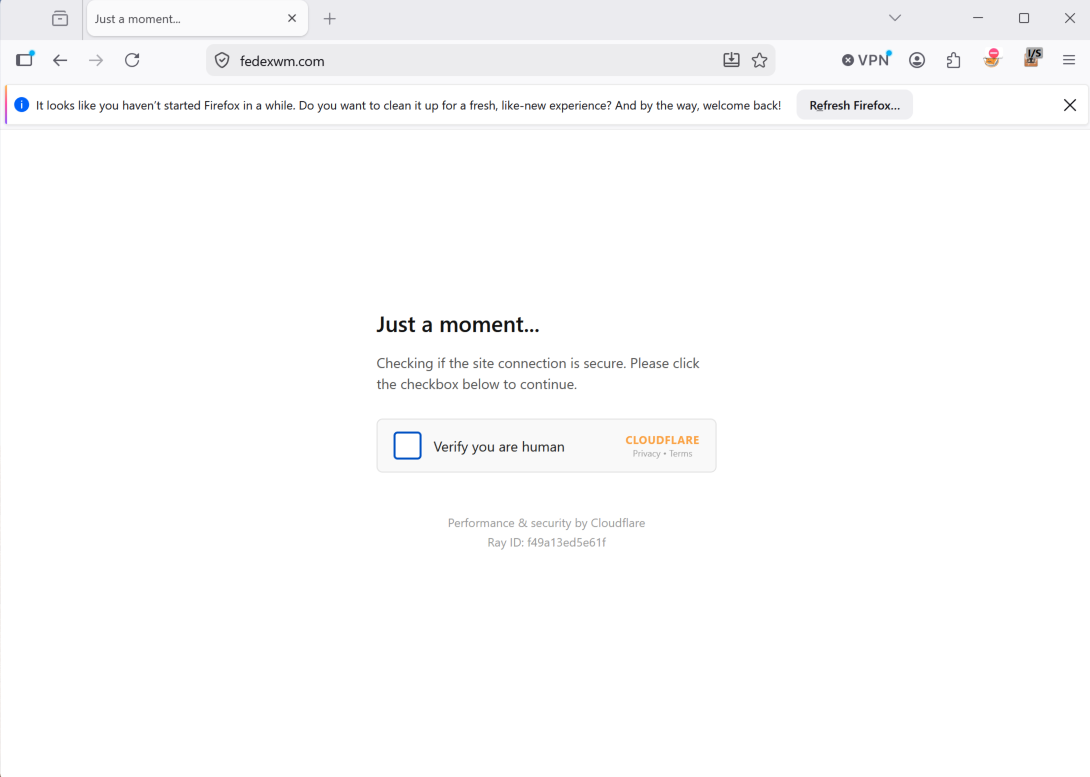
Fake Cloudflare-style verification page served on the lookalike FedEx domain. Fake hCaptcha. The second domain is a
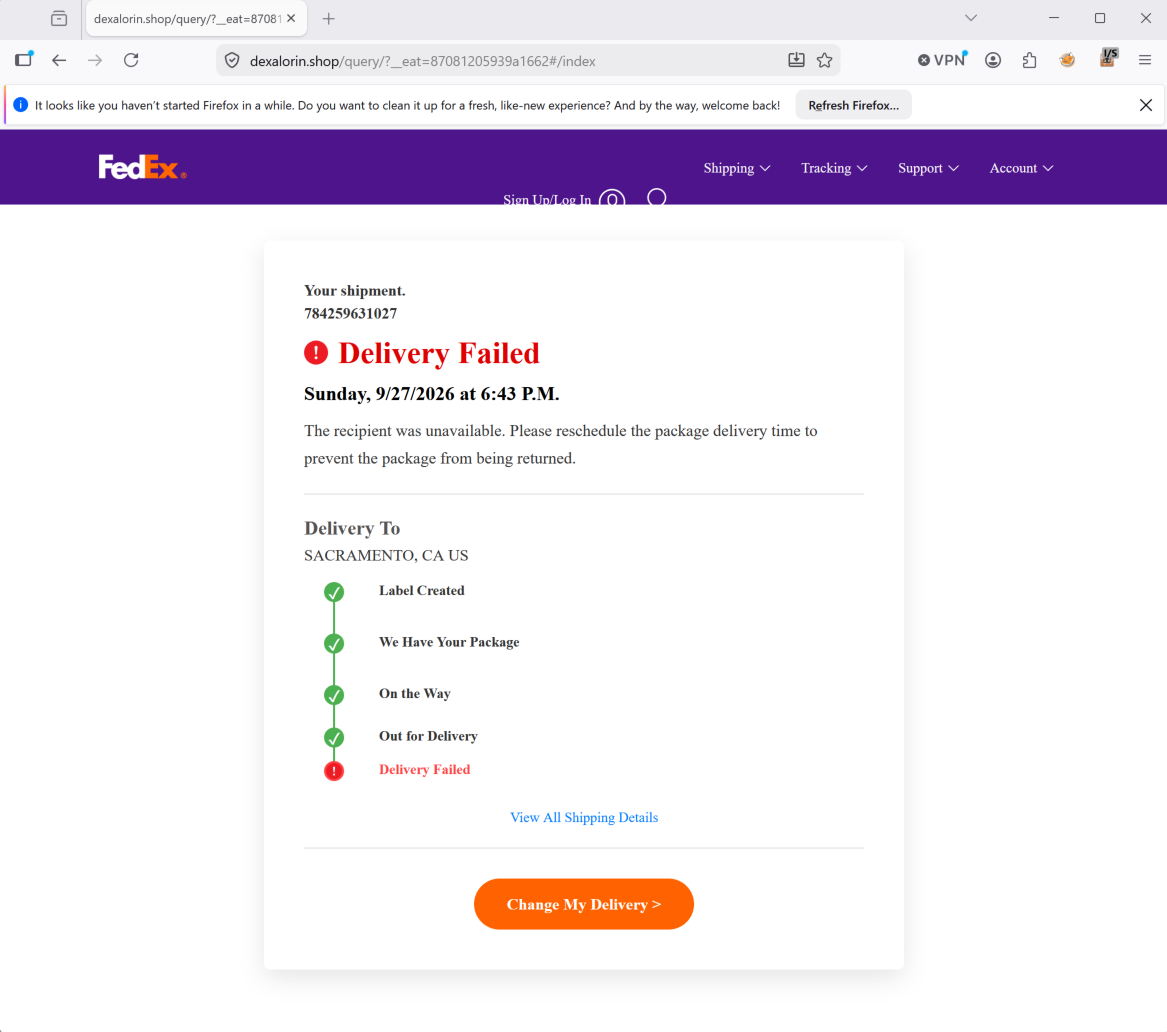
.shopaddress that rotates too:dexalorin[.]shopbehind fedexwm,bifrentov[.]shopbehind fedexyd. It shows a mock hCaptcha checkbox drawn in SVG and CSS, with no call to the real service. Clicking it appends a session token (__eat) and reloads into the payload. FedEx’s fraud page currently warns about messages that link to.shopdomains.Cloned Tracking Page. A FedEx-branded app shows a fake tracking number, 784259631027, and a failed-delivery status. On load it opens a Socket.IO WebSocket to
/console/, a live channel back to the operator’s panel typical of kits built for real-time fraud.Personal Data Harvest. The victim picks a new delivery window and enters their full name, street address, email, and phone number.
Card Harvest. A payment page, citing a supposed FedEx policy, charges $1.20 for redelivery and asks for the card number, expiry, and CVV. A test card drew an error asking for a different card, on a button that misspells “another”. The fee is a pretext; the card, and ideally a second one, is the goal.
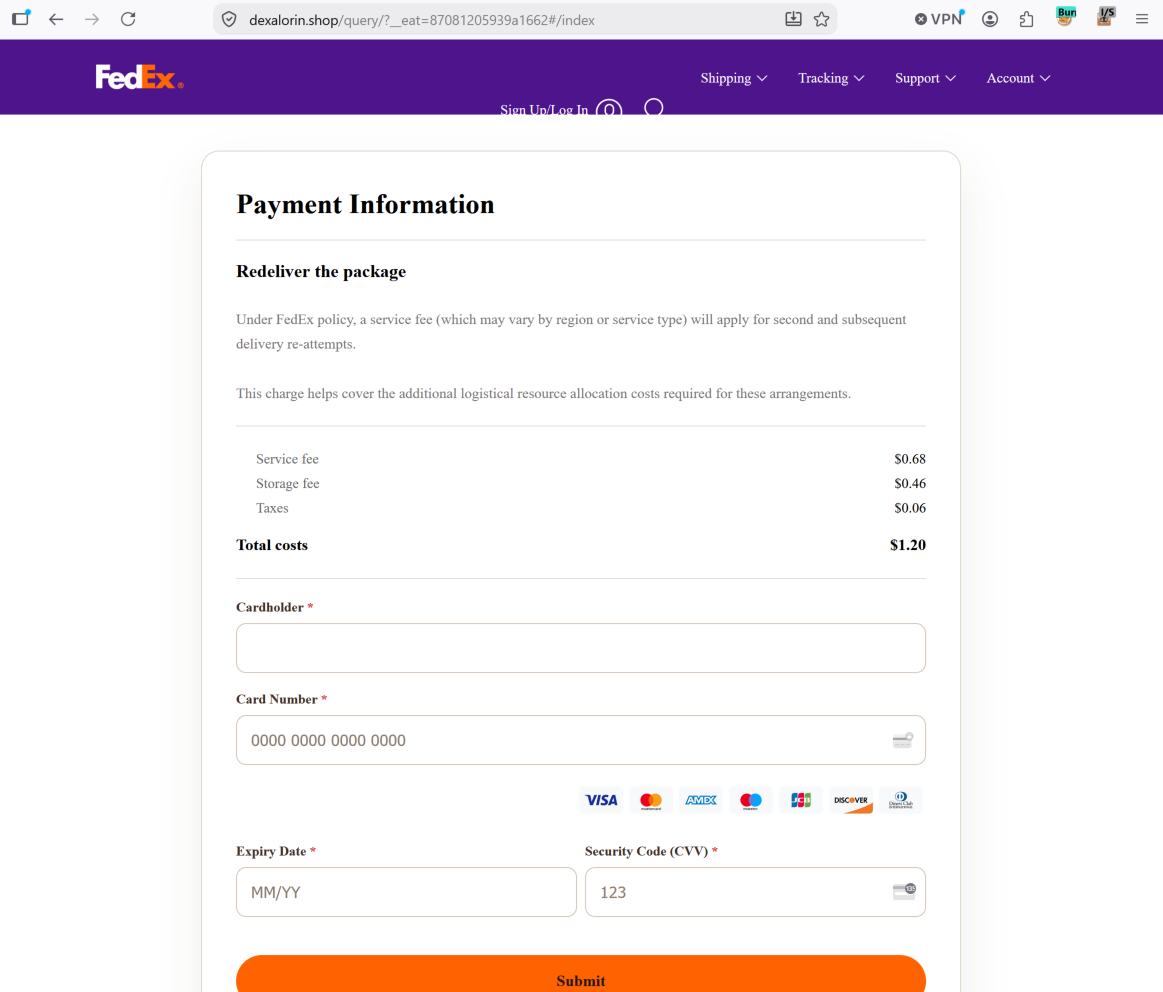
Fake FedEx payment page requesting card details for a $1.20 redelivery fee.
Why it still works
- Voice Skips the Filters. Carrier SMS filtering and email gateways never see a voicemail, and the transcript hands the victim a working link anyway.
- A Small, Plausible Ask. Most people are expecting a package at any given time, and $1.20 is too little to feel like fraud.
- Borrowed Security Theater. Two familiar bot checks make the site feel protected. They also hide the payload: the domain in the voicemail never serves anything FedEx-branded, so a crawler or registrar checking it sees only a generic verification page, or, from a desktop browser, apple.com.
Signals to watch for
- A Voicemail That Names a Website. Real FedEx tracking lives on
fedex.com. A voicemail pointing anywhere else to fix a delivery is the lure. - A “fedex” Plus Letters Domain. Names like
fedexyd[.]comorfedexkmw[.]combelong to this campaign’s rotation, not to FedEx. - A Link That Opens apple.com on a Computer. The gate redirects desktop browsers to Apple’s homepage and shows the scam only to phones.
- A Bot Check Before a Tracking Page. A Cloudflare or hCaptcha check that hands you off to an unrelated domain, such as a
.shopaddress, is the kit, not the carrier. - Fake Cloudflare Artifacts. A real Cloudflare challenge carries
Server: cloudflareand acf-rayresponse header. One served byuvicornor another origin, with a Ray ID that appears in no header, is fake. - Infrastructure Signals. WebSocket upgrades to
/console/?uuid=...&EIO=4and POSTs to/api/click_reporton newly registered domains are high-confidence indicators of this kit, as is auvicornorigin that answers desktop user agents with a302tohttps://www.apple.com.
How to defend against it
- Check the package at the source. Look up the shipment yourself on
fedex.comor in the FedEx app. Never visit a domain read out in a voicemail. - Report the number. Use your phone’s report-spam option, and in the US file a report at reportfraud.ftc.gov.
- For card issuers: reissue on a reported delivery-fee scam rather than monitoring. The kit collects name, billing address, card number, expiry, and CVV, everything card-not-present fraud needs.
- For security and brand teams: block the domains and IPs below, but match on the pattern rather than the list. The gate has run on at least eight addresses at three hosting providers, and new lure domains register almost daily on a small set of nameservers (
share-dns,dyna-ns, Njalla). Registrars had suspended about two thirds of the lure domains by October 7 without slowing the rotation, so report the payload.shopdomain with every lure; removing only the one in the voicemail leaves the kit free to point a new lure at the same payload.
Why it appears here
Package-delivery scams are among the most common consumer lures, and this campaign shows the kits behind them maturing: a voice channel that bypasses message filtering, a clean redirector domain that hides the brand abuse, and a live operator channel on the payload. Nothing in the gate or the operator channel is specific to FedEx, and the lookalike domains the chain depends on are visible at registration, before the first voicemail goes out: about 280 in five weeks, all following one pattern. Both domains respond to the registrar and hosting-provider abuse process described in our phishing site takedown guide.
Indicators of compromise
Lookalike FedEx domains
- Pattern:
fedex[a-z]{1,3}\.com. As of October 7, 2026, 129 domains in this pattern are tied to the campaign, and about 280 were registered in it from September 3. - Searched for or reported:
fedexwm[.]com,fedexyd[.]com,fedexvy[.]com,fedexvw[.]com,fedexfd[.]com,fedexvr[.]com,fedexpw[.]com,fedexkwp[.]com,fedexgw[.]com,fedexfw[.]com
Domains and URLs
dexalorin[.]shop(fake hCaptcha and FedEx payment app, behindfedexwm[.]com)bifrentov[.]shop(fake hCaptcha and FedEx payment app, behindfedexyd[.]com)/api/click_report?lid=2&tid=21(click telemetry on the gate;lid=34&tid=2250onfedexyd[.]com)/query/?__eat=<token>(payload entry path)/console/?uuid=<uuid>&shopHost=&EIO=4&transport=websocket(operator WebSocket)
IP Addresses
- Gate, Spartan Host:
193.218.201[.]170,193.218.201[.]163,193.218.201[.]211,193.218.201[.]231 - Gate, FastNet Data:
154.23.175[.]6,154.23.175[.]9,154.19.229[.]75 - Gate, Tencent Cloud:
43.172.38[.]49 - Payload:
193.218.201[.]135(dexalorin[.]shop),43.166.131[.]150(bifrentov[.]shop)
Lure Artifacts
- Caller numbers:
+1 (986) 291-9712(observed);+1 (986) 270-3769and+1 (986) 283-3199(reported elsewhere, unconfirmed) - Fake tracking number:
784259631027 - Fee amount: $1.20, split into service, storage, and tax lines
Technical Artifacts
- Server headers:
uvicornwithVia: 1.1 Caddyon the gate;openrestyon the payload host. - Device cloaking: the gate answers desktop user agents with a
302tohttps://www.apple.comand serves the fake check only to mobile user agents. - Gate script: the payload URL is stored base64-encoded in an
encTargetvariable; the fake check is localized into nine languages. - Registration pattern: lure domains registered in batches, often several in the same minute, through Onamae, Gname, Realtime Register, Dominet, Cosmotown, and other registrars, on
share-dns.com/share-dns.net,dyna-ns.net, or Njalla nameservers. - Session cookie:
_vt(UUID value, 10-minute lifetime) on the payload host. - Page metadata:
<meta>tags on the payment app describing it as a login page (purpose,page-type,security-level), plus a long hexkeywordsvalue.
Frequently Asked Questions
Is FedEx tracking number 784259631027 real?
No. 784259631027 is the fake tracking number that the cloned FedEx page in this campaign displays, next to a made-up failed-delivery status. It does not belong to a real shipment. Check any package you are expecting on fedex.com or in the FedEx app, and if you entered card details on the page that showed this number, call your card issuer and ask for a replacement card.
Is fedexwm[.]com legit or a scam?
It is a scam. fedexwm[.]com is a lookalike domain read out in the voicemail; it is not a FedEx site, and FedEx tracking lives on fedex.com. On a phone, the lookalike domain shows only a fake Cloudflare check, then forwards visitors to a second domain with a fake hCaptcha and a cloned FedEx page built to collect personal details and card data.
Is fedexyd[.]com, or another fedex-plus-letters website, a scam?
Yes. fedexyd[.]com is one of more than 120 lookalike domains tied to this campaign since September 2026, each one "fedex" followed by one to three letters and ending in .com, such as fedexvy, fedexhf, fedexkmw, and fedexwm. New ones appear almost daily as registrars suspend the old ones, so a name we have not listed is not a sign that it is safe. FedEx tracking lives only on fedex.com.
Why does the website from the FedEx voicemail open apple.com?
The scam site checks what kind of device is visiting. Phones get a fake Cloudflare check that leads to a cloned FedEx tracking page; computers are redirected to apple.com, so anyone checking the link from a laptop sees a harmless site. The redirect does not mean the website is safe, and Apple has nothing to do with it. Do not open the link on your phone.
How can I tell if a FedEx voicemail is a scam?
A voicemail that sends you to any website other than fedex.com to fix a delivery, or that leads to a fee and a card form, is a scam. FedEx says it never requests payment or personal information in exchange for releasing a package. The recording in this campaign never says FedEx: it warns of an address problem, sets a next-day deadline, and reads out a lookalike domain. Look up the shipment yourself on fedex.com or in the FedEx app instead.
Does FedEx leave voicemails about deliveries?
FedEx does call customers in some cases. FedEx Canada, for example, says a call from 800-463-3339 about unpaid duties and taxes is genuine. But FedEx says it never requests payment or personal information in exchange for releasing a package, so a voicemail that sends you to a website other than fedex.com, or asks for a fee to redeliver a package, is not from FedEx. If you are unsure, look up the tracking number yourself on fedex.com or in the FedEx app.
I entered my card on the fake FedEx page. What should I do?
Call your card issuer using the number on the back of the card, report the fraud, and ask for a replacement card rather than monitoring the old one. The page collected your name, billing address, card number, expiry, and CVV, everything needed to use the card online, and an invalid-card error does not mean the details were not captured. Expect follow-up scams that use the name, address, email, and phone number you entered.