
DomainGuard threat intel, published for defense. Security teams can use it to detect and block this technique; anyone who runs into it can use it to recognize the lure and stay safe. Indicators of compromise are defanged.
What it is
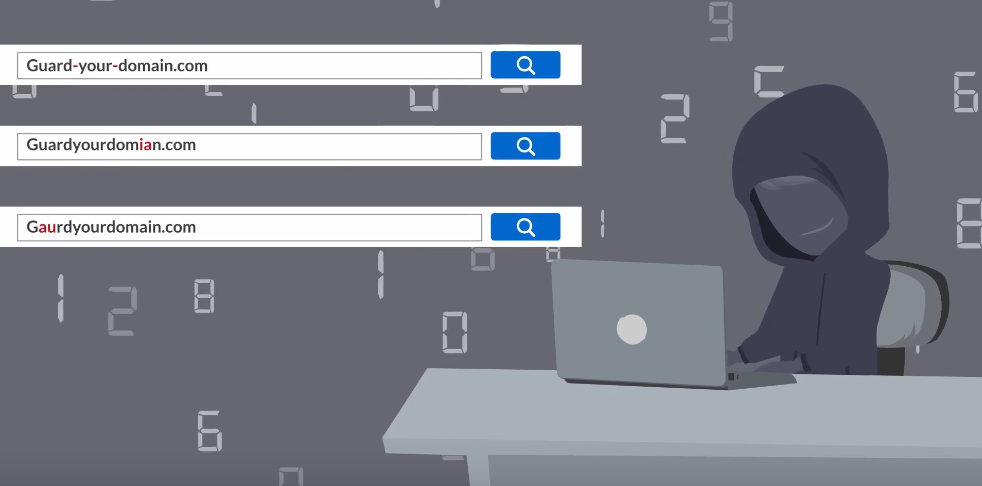
A lookalike domain is one registered to pass for a brand’s legitimate domain. The reader’s eye autocompletes what it expects to see, so gaurdyourdomain.com, guard-your-domain.com, and guardyourdomian.com all read as the real thing at a glance. Security literature uses several overlapping names for the same idea: typosquats, homoglyph or punycode domains, combosquats, doppelganger domains, and cousin domains. Each name describes a registration pattern, but the intent is constant, borrowing a brand’s trust to deceive its customers, employees, or partners.
Lookalike domains are rarely the attack itself. They are the infrastructure layer under credential phishing, invoice fraud, malicious search ads, fake storefronts, and malware delivery. That is why they anchor this catalog: most entries here either start with one or lean on one.
Common Patterns
- Typosquatting. Variants built from typing and reading errors: swapped adjacent letters (
gaurdforguard), doubled or dropped characters, transposed syllables, and wrong-key substitutions. These catch both fat-fingered direct navigation and skim-reading victims of phishing lures. - Homoglyphs and punycode. Characters that render identically or near-identically to the real ones, such as the digit
1forl,rnform, or a Cyrillicаfor a Latinavia internationalized domain names. The registered name is technically different while visually indistinguishable. See the homoglyph glossary entry for the encoding details. - Combosquatting. The brand name kept intact with words attached:
acme-support.com,acme-billing.net,login-acme.com. Nothing is misspelled, which defeats users who were taught to check for typos, and permutation tools miss these because the variant space is unbounded. - Doppelganger domains. Dot-omission variants of real hostnames, like
usacmecorp.comstanding in forus.acmecorp.com. Beyond visual deception, a doppelganger with mail service configured quietly collects email that was misaddressed by one keystroke. - TLD swaps. The exact brand name on a different ending:
.help,.support,.jobs,.shop, or a country-code TLD. Unrestricted new TLDs make this cheap, and some lend the attacker free legitimacy, as the fake-university ring did with.educationand.universityregistrations.
How Attackers Use Them
The same registration serves whichever campaign the operator runs next:
- Credential phishing. The lookalike hosts a cloned login page, and the lure arrives by email, SMS, or chat. The domain in the address bar is doing the convincing.
- Business email compromise. A cousin domain of a vendor or executive sends the “updated banking details” email. No malware is involved, so the domain’s plausibility carries the entire fraud.
- Malicious ads. Paid search placements route brand searches to the lookalike, outranking the real site. The Google Ads phishing entry documents the pattern.
- Malware staging and C2. Lure kits such as the fake Cloudflare verification overlay are routinely served from fresh lookalike registrations, and innocuous-looking domains make durable command-and-control endpoints.
The Staging Window
Lookalike domains usually go live before the campaign does. Operators register in bulk, park the domains with placeholder content, and weaponize them hours to weeks later. The capture below shows a combosquatted Chase lookalike, secure01c-chasebanking.com, observed while still parked on placeholder text before any phishing content was deployed.
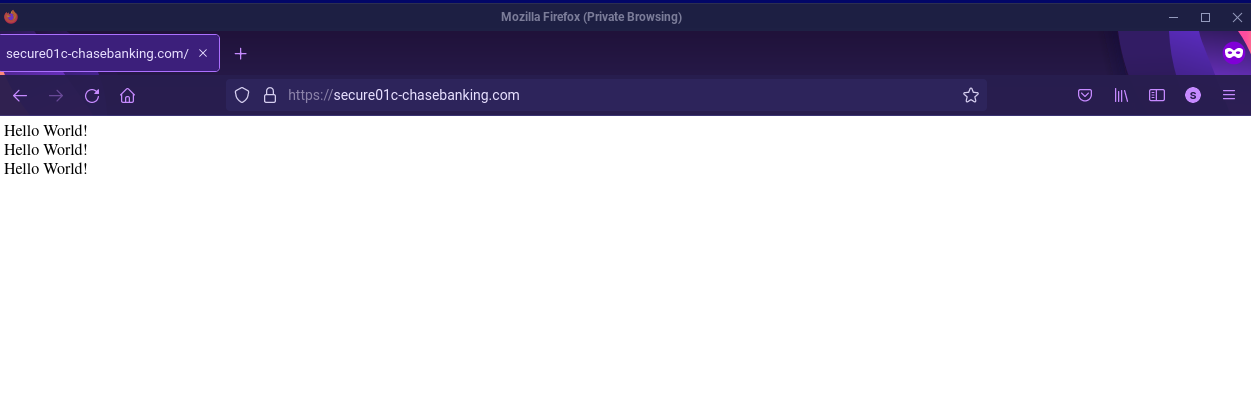
That gap between registration and weaponization is the defender’s best lead time. A new lookalike registration is a signal; a lookalike that adds MX records, requests a TLS certificate, or stands up a login form is a countdown. Catching the domain during staging turns incident response into prevention: the gateway block and the takedown groundwork happen before the first lure lands.
Lookalike Domain Monitoring: How to Find Them
- Permutation scanning. Open-source engines such as dnstwist generate typo, homoglyph, and TLD variants of a seed domain and probe which ones resolve. Our open-source domain monitoring post covers the tooling stack.
- Certificate transparency logs. Nearly every phishing page serves HTTPS, and every publicly trusted certificate lands in CT logs. Watching the logs for brand strings surfaces lookalikes at certificate issuance, often before content exists.
- New-registration and zone feeds. Daily registration data catches variants at creation time, including ones a permutation list would never predict.
- Visual-similarity scoring. Combosquats and unbounded word combinations require scoring candidate domains against the brand rather than enumerating variants. This is where automated feeds need an analysis layer on top.
How to Stop Lookalike Domain Attacks
- Monitor continuously. Every defense below depends on knowing the lookalike exists. Detection during the staging window is the difference between blocking a domain and cleaning up after it.
- Block at your edge. Feed detected lookalikes to the email gateway, web proxy, and DNS filter so lures dead-end even if a takedown drags.
- Take down active abuse. Once phishing or fraud content is observable, report it to the registrar and hosting provider. The process is free and documented in our phishing site takedown guide.
- Register the short list defensively. Own your exact name on the major TLDs and the most obvious typos. Accept that full coverage is impossible and let monitoring cover the long tail.
- Use trademark process where abuse reports cannot reach. UDRP arbitration and ACPA claims can transfer or forfeit a squatted registration itself, at legal speed rather than abuse-desk speed.
- Do not confuse DMARC with lookalike defense. SPF, DKIM, and DMARC stop spoofing of your exact domain. A lookalike is a different domain the attacker legitimately owns, with its own passing email authentication.
First Documented
Lookalike registrations are as old as the commercial web, and the most famous early case targeted the web’s own plumbing. In the late 1990s an Australian operation ran a copycat registry at internic.com, one TLD away from internic.net, where Network Solutions ran InterNIC, then the only place to register a .com. Users who typed “internic” into a browser or search engine landed on the copycat, which charged $250 for the $100 registration, quietly forwarded the real fee to Network Solutions, and kept the difference. The FTC warned the operators in 1997, and by the time a joint FTC and Australian ACCC action shut the site down in 1999, as many as 13,000 victims in at least nine countries were owed refunds. The very system that issued domain names was the first big brand to lose customers to a lookalike of itself.
The same era produced the rest of the legal scaffolding: typosquatting disputes had become common enough by 1999 that ICANN adopted the UDRP arbitration process and the United States passed the Anticybersquatting Consumer Protection Act, both that year. Homoglyph attacks were demonstrated against internationalized domain names in the early 2000s, doppelganger email interception was documented by researchers in 2011, and combosquatting was formally measured at scale in academic work in 2017. The technique predates and outlives every individual campaign built on it.
Why It Appears Here
Lookalike domains are the common denominator of this catalog. The Google Ads entry runs on them, ClickFix lure pages are staged on them, smishing kits link to them, and the fake-university ring was eighteen of them. Registration data, certificate transparency, and permutation analysis make this one of the few techniques defenders can reliably see before it is used, which is exactly why lookalike domain monitoring is the foundation of the discipline. The window between registration and weaponization is short, but it is real, and it belongs to whoever is watching.
Frequently Asked Questions
What is the difference between a lookalike domain, a doppelganger domain, and a cousin domain?
Lookalike domain is the umbrella term for any domain registered to resemble a legitimate one. A doppelganger domain is a specific variant that drops the dot from a hostname, like usacmecorp.com imitating us.acmecorp.com, and it can silently receive email that was meant for the real host. Cousin domain is common in email-security writing for related-word variants such as acme-billing.com. All three deceive the same way: they read as the brand at a glance.
How do I find lookalike domains targeting my brand?
Permutation tools like dnstwist generate and probe thousands of typo, homoglyph, and TLD variants of a domain. Certificate transparency logs surface lookalikes the moment they request an HTTPS certificate, and new-registration feeds catch them at creation. Continuous monitoring combines those sources with visual-similarity scoring so brand-plus-word combinations are caught too, since those never appear in a simple permutation list.
Should I register lookalike domains defensively?
Register a small set of the highest-risk variants: your exact name on major TLDs, the obvious one-character typos, and the hyphenated form. Beyond that the math stops working. Permutation engines generate thousands of plausible variants per brand, new TLDs launch every year, and attackers only need one gap. The scalable posture is defensive registration for the short list plus monitoring and takedown for everything else.
How do I stop lookalike domain attacks?
Monitor for new registrations and certificates resembling your brand, block detected lookalikes at your email gateway and web proxy, and pursue takedowns as soon as abuse is observable. Report phishing to the registrar and host, and use UDRP or ACPA proceedings for trademark cases that abuse reports cannot reach. Email authentication such as DMARC stops spoofing of your exact domain but does nothing against lookalikes, so treat the two as separate defenses.
Can a lookalike domain be taken down before it hosts phishing?
Usually not through abuse channels. Registrars act on documented abuse, and a parked lookalike with no content gives them nothing to act on. Trademark holders can pursue UDRP arbitration or ACPA claims on the registration itself, but those run on legal timelines measured in weeks to months. The practical play during the parked window is monitoring the domain for weaponization signals like MX records and certificates, then moving the moment abuse appears.