
DomainGuard threat intel, published for defense. Security teams can use it to detect and block this technique; anyone who runs into it can use it to recognize the lure and stay safe. Indicators of compromise are defanged.
What it is
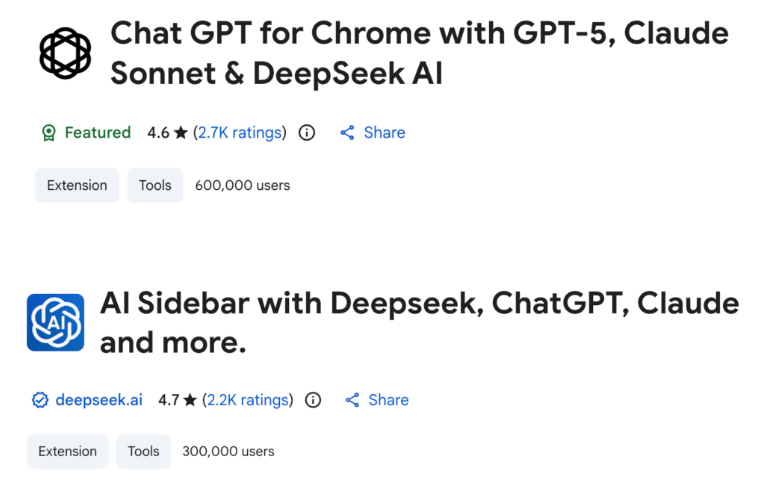
“Prompt Poaching” is a data theft technique executed by malicious browser extensions disguised as helpful AI productivity tools. In late 2025 and early 2026, a massive campaign distributed extensions impersonating legitimate services like AITOPIA, presenting themselves as “AI Sidebars” or unified interfaces for ChatGPT, Claude, and DeepSeek.
These extensions successfully gained over 900,000 installations, with some even earning a “Featured” badge on the Chrome Web Store. Once installed, they abuse broad browser permissions to monitor the user’s active tabs and silently scrape sensitive data from AI chatbot interfaces.
How it works
- Deceptive Installation and Permissions. The user installs the extension from the Web Store. During setup, the extension requests permission to “Read and change all your data on the websites you visit,” often burying this broad access under a fake privacy policy hosted on platforms like Lovable.dev, claiming to only collect “anonymous, non-identifiable analytics.”
- Targeted DOM Scraping. The malware actively monitors the browser’s active tabs. When the user navigates to specific high-value targets like
chatgpt.comordeepseek.com, the extension injects JavaScript to perform DOM (Document Object Model) scraping. - Data Harvesting. The injected script reads the text directly from the chat window in real time. It captures both the user’s prompts (which may contain proprietary code, internal strategies, or PII) and the AI’s responses.
- Exfiltration. Approximately every 30 minutes, the harvested data is Base64-encoded. The extension packages the chat logs, session tokens (enabling account takeover), and a list of all currently open tab URLs (revealing internal corporate structures or intranet applications).
- C2 Communication. This payload is exfiltrated via background requests to attacker-controlled command-and-control (C2) domains, such as
chatsaigpt[.]comordeepaichats[.]com. - Persistence. The threat actors use overlapping extension networks. If a user uninstalls one malicious extension, a redirect may trigger, prompting them to install a “backup” or “updated” version of the same malware under a different name.
Why it still works
- The Illusion of Utility. Fraud operators love “helpful” tooling. A sidebar that promises to combine GPT-5, Claude, and DeepSeek into one window provides immense perceived value, encouraging users to ignore permission warnings.
- Trust in Badges. The presence of a “Featured” badge on the Chrome Web Store provides a false sense of security, bypassing the user’s natural skepticism.
- Browser-Level Visibility. If an extension can read the page, it can read the chats. This technique scales effortlessly because the browser naturally decrypts TLS traffic to render the page, allowing the extension to steal the data post-decryption.
Signals to watch for
- Overly Broad Permissions. Extensions requesting “Read and change all your data” when their advertised functionality only requires access to a specific site or sidebar.
- Outbound Traffic to Lookalike Domains. Network telemetry showing regular outbound connections to domains mimicking AI brands (e.g.,
chatsaigpt[.]com) from the browser process, especially if the user is not actively interacting with the extension. - Unexpected Redirects. Users experiencing automated redirects to the Chrome Web Store after uninstalling an extension.
- Session Token Anomalies. Unexplained session hijacking or access to AI accounts originating from IP addresses that do not match the user’s typical location.
How to defend against it
- Run an extension allowlist. Chrome Enterprise policies make deny-by-default enforceable: block all extensions with
ExtensionInstallBlocklistset to*, then approve the ones you need throughExtensionInstallAllowlistorExtensionSettings. Users request additions instead of installing freely. - Block the known IDs now. Add the extension IDs listed below to your blocklist, and the C2 domains to DNS and proxy blocks.
- Audit what is already installed. Chrome’s browser management reporting, or your EDR’s extension inventory, shows which extensions hold broad host access. A sidebar tool that can read and change data on every site is a finding, not a feature.
- Treat AI chat as a sensitive surface. Keep secrets and customer data out of prompts, and prefer enterprise AI accounts that come with admin controls and audit logs.
- Rotate what may have leaked. If a listed extension was installed, sign out of AI accounts everywhere, rotate any API keys or credentials ever pasted into a chat, and review the internal URLs its tab list could have exposed.
Why it appears here
Prompt Poaching turns user trust into persistent telemetry. As organizations increasingly rely on LLMs for development and strategy, the chat window has become one of the most sensitive surfaces on the endpoint. We track these malicious extensions because they bypass network security controls by operating directly within the browser, demonstrating why strict, “deny-by-default” extension policies are necessary for corporate environments.
Indicators of compromise
Command and Control (C2) Domains
chatsaigpt[.]comdeepaichats[.]com
Known Malicious Extension IDs
fnmihdojmnkclgjpcoonokmkhjpjechg(“Chat GPT for Chrome with GPT-5, Claude Sonnet & DeepSeek AI”)inhcgfpbfdjbjogdfjbclgolkmhnooop(“AI Sidebar with Deepseek, ChatGPT, Claude, and more”)
Further reading
- OX Security report on the Prompt Poaching campaign: Malicious Chrome Extensions Steal ChatGPT, DeepSeek Conversations
- Hacker News coverage: Millions of Users Exposed as Malicious Chrome Extensions Target AI Chatbots