
DomainGuard threat intel, published for defense. Security teams can use it to detect and block this technique; anyone who runs into it can use it to recognize the lure and stay safe. Indicators of compromise are defanged.
What it is
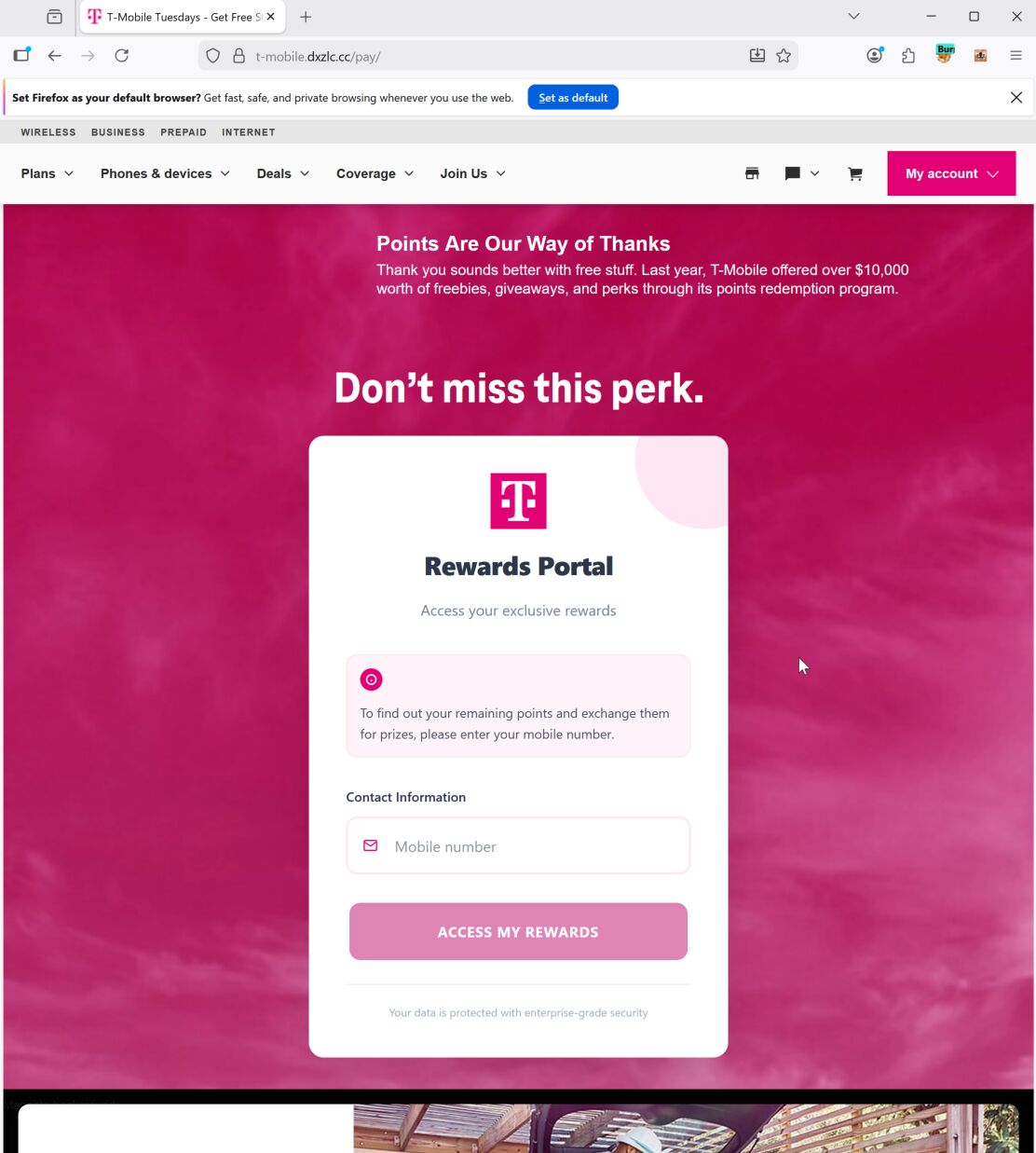
T-Mobile SMS phishing, or smishing, is a targeted social engineering attack where victims receive a text message appearing to be from T-Mobile. The message typically warns of a billing issue or an urgent account update, directing the victim to a lookalike domain. These campaigns are designed to harvest sensitive payment information and one-time password (OTP) codes in real-time.
The kit identified in this campaign uses modern web techniques to evade automated detection and maximize the value of stolen data. By leveraging Cloudflare for infrastructure protection, the attackers increase their uptime and complicate efforts to identify the true origin of the malicious servers.
How it works
Lure and Redirect. The victim receives an SMS with a link to a campaign-specific URL, such as
t-mobile[.]dxzlc[.]cc/pay?qr=<token>. Theqrparameter acts as a tracking token to identify specific victims or campaigns. Upon clicking, the victim is redirected to a clean/pay/path.Victim Fingerprinting. Before showing the phishing page, the kit calls external APIs like
ipinfo.io/jsonto collect the victim’s IP address, geographic location, and ASN. This data is used for bot filtering (blocking security researchers) and to ensure the victim matches the targeted demographic.Click Logging. The visit is logged to the attacker’s backend via a
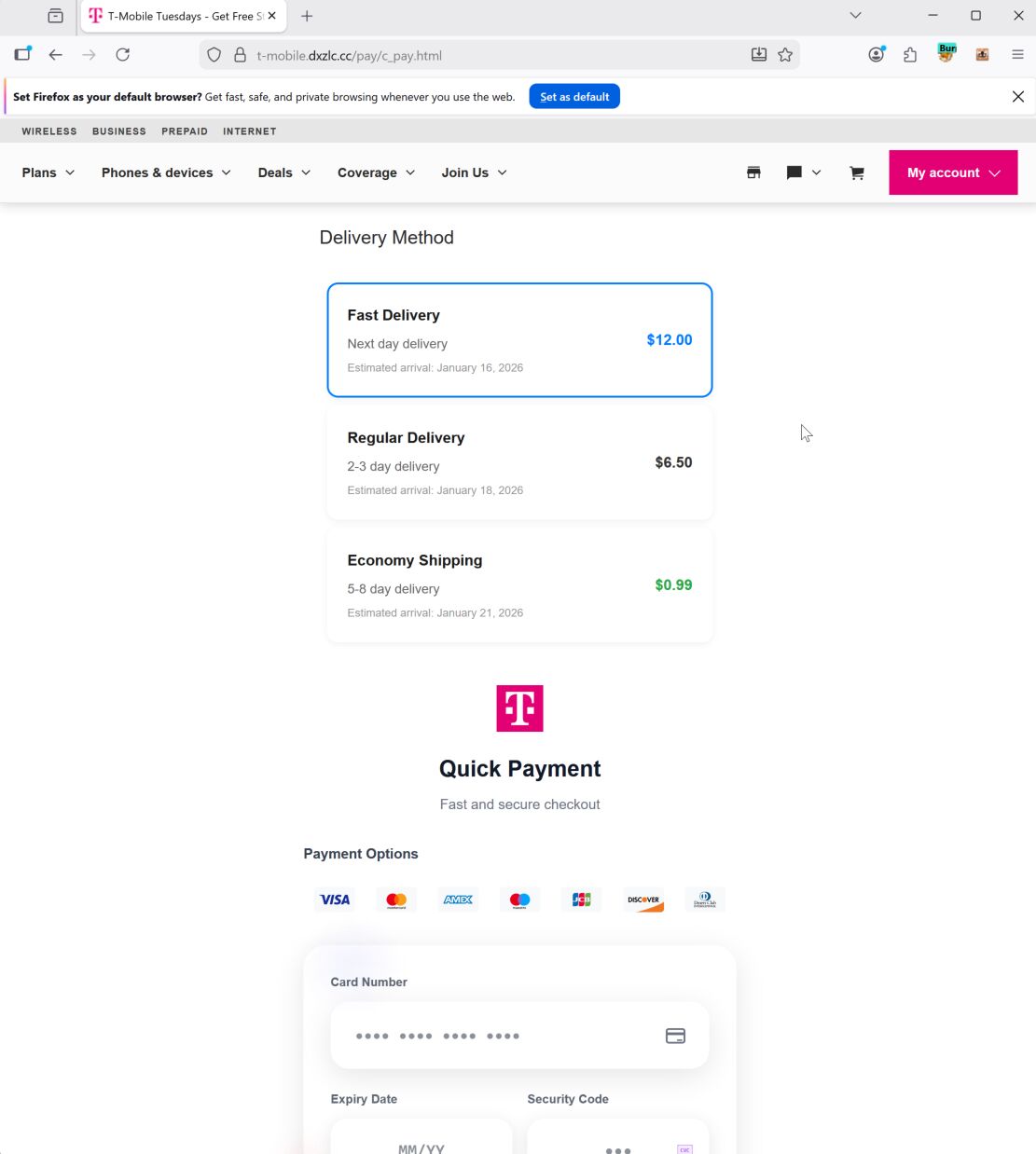
POST /api/open/addClickrequest. This allows the phisher to track the conversion rate of their campaign in real-time.Fake Payment Interface. The victim is presented with a pixel-perfect T-Mobile checkout page. Instead of a legitimate payment processor, the card data is sent directly to the phisher’s API:
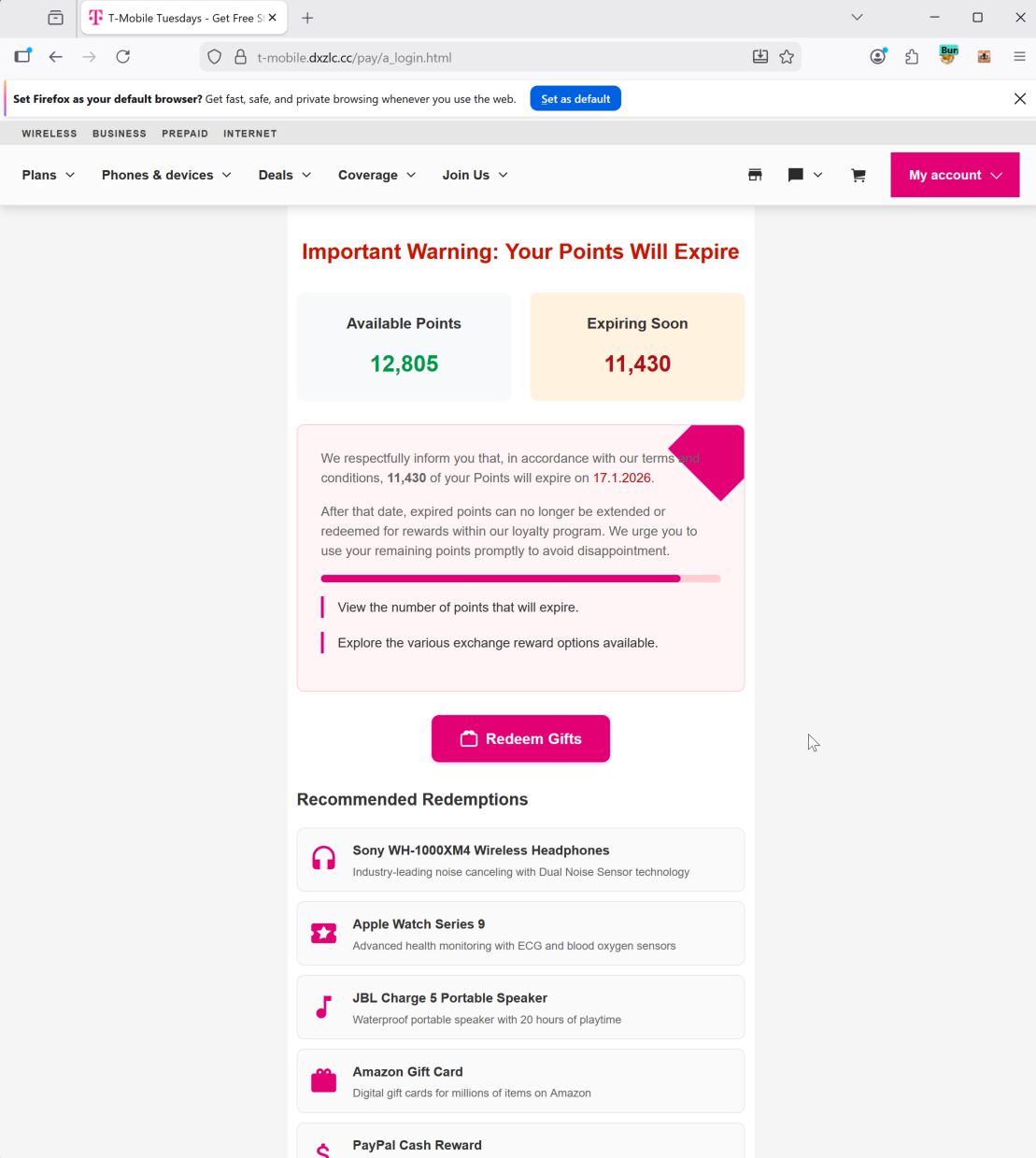
T-Mobile themed smishing landing page showing a fake payment interface. POST /api/open/addCvv
BIN Enrichment. As the victim types their card number, the kit performs a
POST /api/bin/queryto identify the issuing bank and card type. This allows the attacker to verify the card’s validity and determine if it is a high-value target (e.g., a corporate or premium card).Real-Time OTP Harvesting. The flow concludes by prompting the victim for an SMS OTP. This is a critical step in modern fraud workflows, such as provisioning the stolen card into a digital wallet (Apple Pay/Google Pay) or bypassing MFA for an account takeover.
Real-time OTP prompt presented after the credit card data is captured.
Why it still works
- Urgency and Trust. Using a well-known brand like T-Mobile creates a sense of urgency. Victims are often caught off guard by payment-failure notifications and act quickly to avoid service interruption.
- Mobile Context. Smishing is highly effective because users are more likely to click links in SMS than in email, and the smaller screen of a mobile device makes it harder to inspect the full URL and security certificates.
- Real-Time Interaction. By harvesting OTPs while the victim is still on the site, attackers can use the stolen credentials immediately, often before the victim or the bank realizes a theft has occurred.
Signals to watch for
- Suspicious TLDs. T-Mobile will never use domains ending in
.cc,.top, or other generic top-level domains for official billing. - Requests for OTPs on Payment Pages. Legitimate payment flows may use 3D Secure, but they will never ask you to paste an SMS code into a non-bank page to “verify” a T-Mobile account.
- Unexpected “Verification” Steps. T-Mobile does not require you to complete a checkout flow to fix a general account “error” sent via text message.
- Infrastructure Signals. Traffic to backend API paths like
/api/open/addCvvor/api/bin/queryon non-standard domains is a high-confidence indicator of a phishing kit in operation.
How to defend against it
- Report the text, do not tap it. Forwarding a smishing message to 7726 (SPAM) lets US carriers block the sender and the link for everyone else.
- Pay only through the app or a typed-in address. A real billing problem shows up when you sign in to your account yourself, never only through a link in a text.
- Never give an SMS code to a page you reached from a text. One-time codes authorize wallet provisioning and account changes; a payment page asking for one is the attack itself.
- For card issuers: treat a new digital-wallet provisioning request that follows an OTP challenge on a first-seen device as high risk, and step up verification before approving it.
- For security and brand teams: block the kit’s lookalike domains at DNS and take them down. These kits run on short-lived domains that respond to the standard abuse process.
Why it appears here
T-Mobile smishing is a high-volume threat that consistently targets consumer mobile users. This specific kit highlights the move toward “API-driven” phishing, where the frontend is a thin wrapper around a malicious backend that handles everything from victim tracking to real-time data enrichment. We monitor these campaigns to track the evolution of the underlying kits and to provide early warning for lookalike infrastructure. Smishing landing domains respond to the same registrar and hosting-provider abuse process described in our phishing site takedown guide.
Indicators of compromise
Domains and URLs
t-mobile[.]dxzlc[.]cc/api/open/getSyncSettings/api/open/addClick/api/open/addCvv/api/bin/query/api/open/getPendingInstruction/
Technical Artifacts
- Server Header:
cloudflare - Frontend Framework: Often uses common libraries (Vue/React) but obfuscated to prevent signature-based detection.